


What is Radon?
A naturally occurring radioactive gas found indoors. 86Rn
Radon is a naturally occurring radioactive gas that forms from the decay of uranium in soil, rock, and water. It is colorless, odorless, and tasteless, making it impossible to detect without proper testing. Radon can accumulate indoors, especially in basements and lower levels of buildings, posing a significant health risk.

Health Canada
Radon is the #1 cause of lung cancer in non-smokers, Be with us
1
How Radon Gets Into Your Home
Radon enters through foundation cracks, sump pits, and pipe openings.
2
Radon Levels in Canada
Radon levels vary nationwide, with Prairie provinces averaging 120–150 Bq/m³, and about 1 in 5 homes exceeding Health Canada’s 200 Bq/m³ guideline.
3
Health Effects of Radon Exposure
Long-term radon exposure damages lung tissue and is the second leading cause of lung cancer in Canada.

≥
1
Bq/m³
The Prairie Canada and the Northwest Territory Region encompasses the provinces of Alberta (AB, pop. 4,262,635), Manitoba (MB, pop. 1,342,153), Saskatchewan (SK, pop. 1,132,505), and the Northwest Territories (NT or NWT, pop. 41,070), and contains 20% of all Canadian residential building types reported in this study.
Radon’s Impact on Health
Long-term exposure to radon is the second leading cause of lung cancer after smoking. According to the World Health Organization (WHO) and Health Canada, prolonged radon inhalation can damage lung tissue and increase the risk of lung cancer. The risk is higher for smokers, but non-smokers are also at risk if exposed to elevated radon levels over time.
Radon in Canada
Radon levels vary across Canada due to differences in geology and soil composition. Health Canada recommends that indoor radon levels not exceed 200 Bq/m³ (becquerels per cubic meter). Homes and buildings should be tested for radon, especially in high-risk areas identified by government studies. Provincial regulations may also require radon mitigation in new construction projects.
Colorless, Odorless & Tasteless
Radon is a colorless, odorless, and tasteless radioactive gas formed naturally from the breakdown of uranium in soil and rock. Because it cannot be detected by human senses, there are no immediate warning signs when levels are elevated indoors. Homes can have dangerously high radon concentrations without occupants ever knowing. The only reliable way to determine radon levels is through proper long-term testing using approved radon measurement devices.
How Radon Enters Your Home
Radon seeps into buildings through:
• Cracks in foundations and basement floors.
• Gaps around pipes, drains, and wiring.
• Construction joints and wall cavities.
• Well water supply (less common but possible source).
Since radon is a gas, it can accumulate in enclosed spaces, reaching dangerous levels without warning. The only way to know if your home has high radon levels is through testing.
• Cracks in foundations and basement floors.
• Gaps around pipes, drains, and wiring.
• Construction joints and wall cavities.
• Well water supply (less common but possible source).
Since radon is a gas, it can accumulate in enclosed spaces, reaching dangerous levels without warning. The only way to know if your home has high radon levels is through testing.
New and Old Homes
Radon is not related to the age, cleanliness, or value of a home. Both newly constructed houses and older properties can have elevated radon levels. Modern energy-efficient homes may even trap radon more effectively due to tighter building envelopes. Since radon levels depend largely on underlying soil conditions and airflow patterns, neighboring homes can have very different concentrations. Testing every home individually is therefore critical.
Radon Levels Can Be Reduced
The good news is that high radon levels can be effectively reduced. Professionally installed mitigation systems, such as sub-slab depressurization systems, can lower radon concentrations by 90% or more. These systems safely vent radon gas from beneath the home to the outdoors before it enters living spaces. When properly designed and maintained, mitigation provides long-term protection and significantly reduces health risks for occupants.

Health Canada
Brief History of Radon
1
1890-1910s – First Discovery.
Although radon received its final name in 1923, it was first identified in Canada in 1899 by Ernest Rutherford, Harriet Brookes, and Robert Owens as “radium emanation.” Their groundbreaking research at McGill University in Quebec on radioactive decay laid the foundation for future studies on radon’s properties.
2
1940-1970s – Radon exposure in underground miners.
In the 1940s, Dr. Wilhelm C. Hueper identified radon inhalation as a probable cause of lung cancer, particularly among miners. Later large-scale studies in uranium miners across Canada and Europe confirmed radon’s carcinogenic effects and established it as a significant occupational health risk.
3
1980s – Stanley Watras and
the discovery of residential radon exposure.
Although radon risks in mining were well known by the late 20th century, residential exposure gained attention after the 1984 “Watras Incident.” Stanley Watras triggered radiation alarms at a Pennsylvania nuclear plant due to extreme radon levels—99,900 Bq/m³—in his home. The case sparked widespread residential testing and advanced mitigation efforts worldwide.
4
1988 – IARC classification of radon inhalation
as cancer-causing exposure.
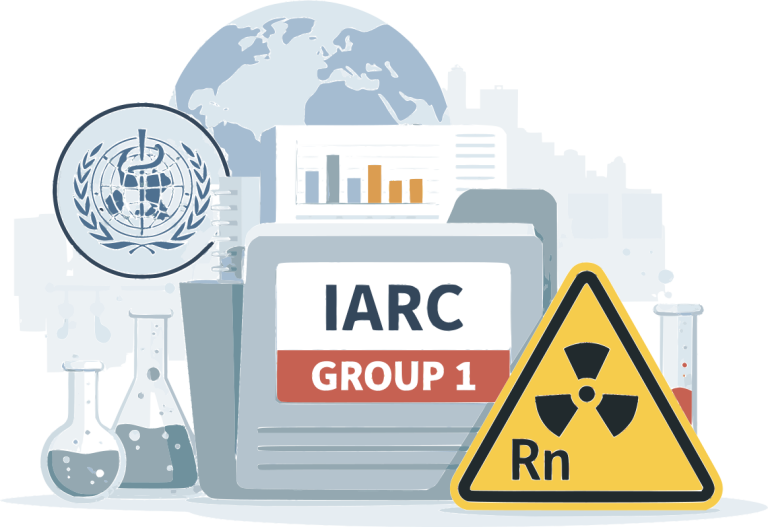
The International Agency for Research on Cancer (IARC), part of the World Health Organization, evaluates cancer risks worldwide. In 1988, IARC classified radon and its decay products as Group 1 carcinogens, confirming they are conclusively cancer-causing to humans.
5
1990s-2000s – Linking residential radon exposure
to lung cancer.
Large epidemiological studies in Europe, North America, and China during the 1990s–2000s confirmed that long-term residential radon exposure increases lung cancer risk. By 2005, pooled analyses showed a statistically significant 16% increase in lung cancer risk for every 100 Bq/m³ rise in average radon levels.



Health Canada
Radon in Canada

1 of
1
properties are at or above
≥
1
Bq/m³
mitigation is requried
1
%
of lung cancer deaths linked to Radon
1
Avg Bq/m³ in Alberta